Are Diamonds a CMO's new best friend?

Part 3 in the series of scaling generative AI in enterprise marketing functions
In Brief
As marketing departments mature with generative AI, a new barrier to value emerges – the operating model. CMOs will need to make 3 shifts to enable a next gen op model that unlocks the promise of agentic AI. The outcome is a "Dynamic Diamond", where a reinvented and empowered middle layer is the new engine of value. This means new roles for all layers of the organization and we explore the potential impact to each.
At this point, your marketing team has likely overcome the barrier of getting started with gen AI. 74% of marketing orgs globally use generative AI in some capacity. Salesforce
The bad news: While improving, enterprise value from gen AI is still elusive. 2025 Wharton research shows that only 26% of large companies are realizing "substantial positive ROI".
The good news: CMOs are undaunted. Most enterprise CMOs have tasted success with efficiency wins and their optimism and confidence in the tech continues to increase every year - which is showing up in their budget plans. The volume of CMOs planning to invest more than $10M annually for the next three years increased by 14pp vs. 2024 (per BCG)
What happens if CMOs are successful?
Let’s assume that this group of smart, driven leaders who put their chips on the table end up overcoming the many significant hurdles to scaling and driving value from gen AI - and have moved to an agentic AI-powered function.
The result? A marketing function that dramatically increases their operational tempo, delivers far greater value for the company, and is positioned to inform the company strategy, not just activate against it.
In theory.
Why? As marketing organizations increase their gen AI maturity, a new bottleneck to value emerges quickly…The operating model.
The classic functional pyramid was built for scarcity
If you’ve worked in a large org, you have probably been part of some version of a classic functional pyramid model - with a top-down, command-and-control structure that really emerged as the most practical way to manage finite resources at scale.
The pyramid shape naturally forms when span of control principles limit how many people any one manager can effectively supervise, creating layers that allocate decision-making authority and resource oversight throughout the organization.
But what happens when resources are not a constraint and you are in a scenario of abundance? Where an army of unlimited AI agents can work while you sleep?
Matan-Paul Shetrit, the head of product at writer.com, wrote this brilliant article that honed in on a key insight on why the role of an organization and it’s people will need to change…
“As AI systems make execution and coordination programmable, the firm’s role evolves. It no longer exists primarily to perform work. It exists to orchestrate the doing of work, routing objectives across a mesh of agents, humans, and hybrid systems.”
So in an era of “unlimited” resources w/ an agentic AI-powered marketing org, the operating model needs to be designed to focus on enabling orchestration.
But when agentic AI is implemented inside an existing pyramid op model?
It's like giving every uber driver in Manhattan an F1 car. Sure they’ve got the horsepower to get downtown in 60 seconds. But the traffic lights aren’t green all the way and the cops pull over anyone going faster than 30 mph.
The transportation system is the issue - it wasn’t built for speed. It was built for safety, control, and coordination.
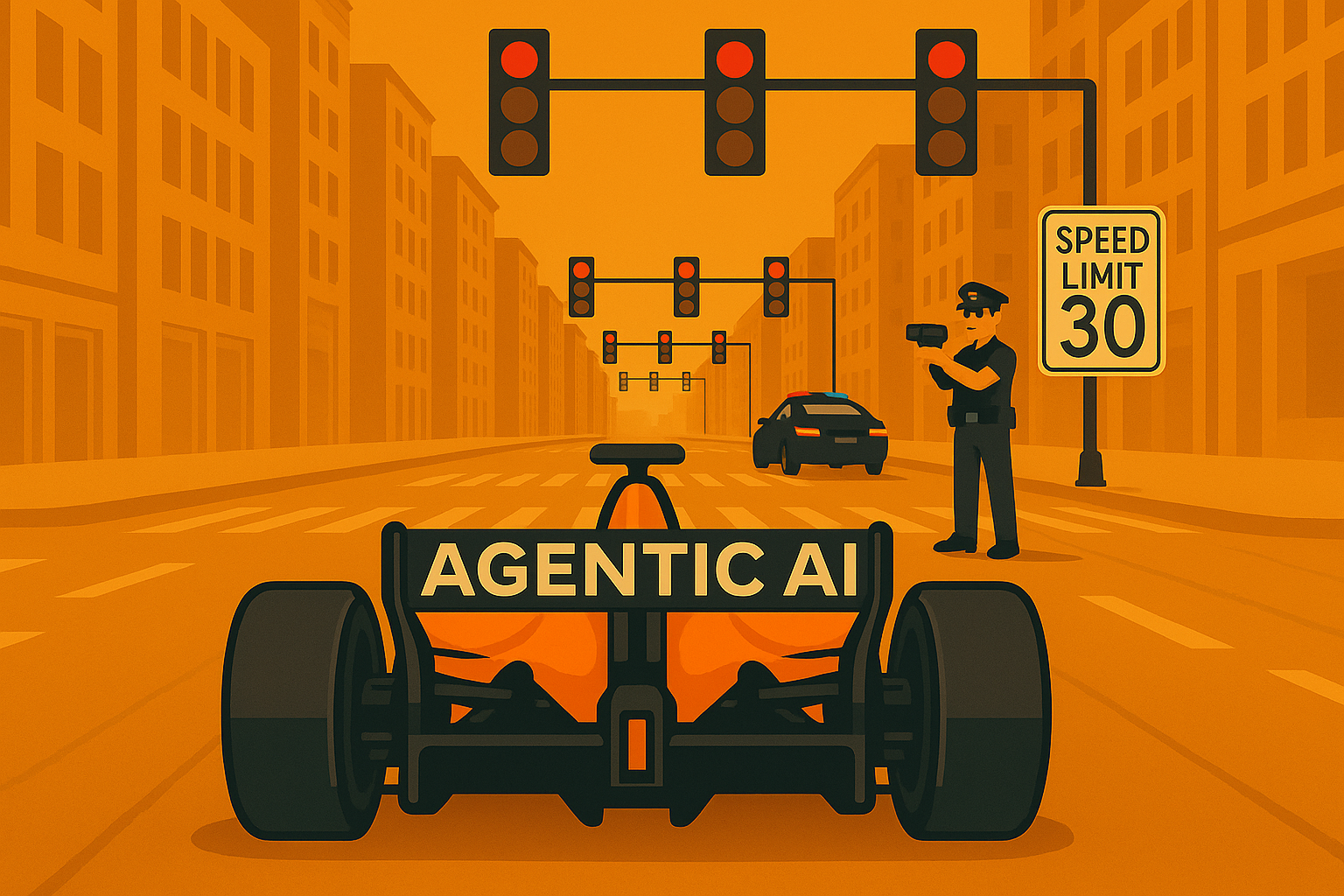
Here are a few tangible examples of the pyramid model bottlenecking agentic AI.
Top-down decision-making: A marketing leadership team meets quarterly to revise strategy, but by the time decisions are aligned and cascade to the execution teams, audiences needs have shifted.
Role-based data permissions: A junior marketer uses GenAI to localize product launches across regions but can’t access existing client data due to permissions for their seniority level. So they default to generic “global” messaging that’s less impactful.
Specialized hiring/narrowly scoped roles: An email channel owner creates a GenAI workflow that auto-optimizes campaign sequencing, but their narrow role excludes them from cross-channel discussions. The innovation could scale broadly but stays hidden due to rigid organizational boundaries.
Enabling orchestration requires CMOs make 3 shifts…
From available research, feedback from AI and brand marketing leaders plus my on-the-ground experience scaling gen AI adoption inside an enterprise marketing org, CMOs will need to drive 3 shifts to help eliminate the speed traps of the pyramid model
Shift 1: Reinvent the middle as orchestrators with new decision authority
Shift 2: Move from static strategy to strategic guardrails
Shift 3: Streamline martech to orbit around a core marketing OS
This article will unpack shift 1.
Shift 1: Reinvent the middle as orchestrators with new decision authority
The question is… who should orchestrate? why the middle layer of an org? And what does that mean for the roles of each layer in the marketing org?
Let’s first start with some context. Large orgs have traditionally been slow and cumbersome (the pyramid grew too fat). The answer? Systematically remove middle management. “The great flattening” trend would help accelerate decision-making, while eliminating costs (improving revenue/employee).
However, in recent years, this was done in part based on the assumption that AI would replace coordination functions and lost productivity.
41% of employees reported they had slashed management layers. Korn Ferry
The avg number of employees per manager has tripled in recent years, from 5:1 in 2017 to 15:1 in 2023. Gartner research via WSJ
By 2026, 20% of orgs will use AI to flatten their structure, eliminating more than half of current middle management positions. Gartner
But there are two tiny little problems
1. It’s not working as expected: While reductions based on a nuanced strategy can be effective, it appears the priority for many was hitting a cost target to share with the street. And without the assumed productivity gains from gen AI realized, the workload on whoever is left increases dramatically. And per Korn Ferry, that has had major negative consequences…
Lack of communication and alignment across the business - 43% of employees say their leaders aren’t aligned and 37% say the lack of managers has left them feeling directionless.
Lower productivity due to lack of leadership support
Increased turnover as limited promotion paths drive top talent to seek opportunities elsewhere.
2. It eliminates the change agents desperately needed for transformation: Well defined playbooks don't exist for AI transformation. And with everything moving so quickly, business as usual = a constantly evolving plan. And that means needing people that can:
Translate vision into action through a windy path
Spot implementation challenges before they become disasters, etc.
Spent the time to communicate changes to bring people along
Reassure employees from a place of trust that their career paths are being taken into account during the journey
This is where the middle is crucial… and that shows up in the research from many sources (incl. this recent one from BearingPoint) - which consistently demonstrates that the middle of an organization is critical to successful transformation outcomes - both engaging them for their buy-in and for driving execution.
Don’t just preserve the middle layer, reinvent it entirely
The middle are not only a crucial group to help drive AI transformation, they also possess the closest combination of thinking and doing skills with the seasoning and experience required for orchestration.
Trust and relationships: They have earned trust from both leadership and junior teams - both by leading successful execution and supporting their team’s career growth.
Institutional knowledge: They have an understanding of the people dynamics, who to go to for what, how to get stuff done, the political quagmires to avoid, etc.
Craft expertise and judgement: They’ve been through the trenches and possess the critical thinking and experience to know what works, what doesn’t, what good looks like and when to question (especially with AI always answering confidently)
Operational knowledge: They understand how work actually happens - the workflows, tools and processes - and already are adept at optimizing them to make their teams more productive.
Supervisory experience: They are already responsible for overseeing human teams, evaluating performance and giving them feedback to optimize outcomes.
Could junior or senior talent step into these roles?
Is it possible? Yes. Is it as probably or as quick a route? No. Junior talent typically don’t have the seasoning required to provide the right level of judgement as an orchestrator or craft expert. Senior talent are often closer in skills and experience, but are not steeped in the necessary detailed operational, workflow or martech knowledge. And as evidenced in the data from Korn Ferry, they are already struggling to drive alignment and oversight…and that’s before adding agents into the mix.
Two middle layer roles: the generalist and the domain expert
As the middle is reinvented (likely a combination of upskilling, reskilling and fresh talent), there is a need for two different roles - people that go wide, with a small set of people that go deep.
1) The Orchestrator - The majority of the middle layer, these are integrated marketing generalists who focus on orchestrating the end-to-end execution of marketing work through a network of humans (employees, contractors, agency personnel) and agents.
Key activities for this group would be to drive the briefs, determine how to solve marketing problems (within the context of the strategic guardrails in shift 2), assemble the network of humans and agents needed to execute and be completely accountable for the marketing execution and ongoing optimization.
While they continue to be measured on marketing performance, they are also judged by how much they can improve orchestration speed & throughput of the networks they assemble.
2) The Craft Expert - A small set of artisans, thought leaders, and practice leaders in different sub-domains of marketing who are responsible for driving consistently high quality of outputs within their area of expertise. The creative lead, the editorial lead, the programmatic media lead, the social channel lead, etc.
Key activities for this group would be to:
Train, measure and optimize the mass-use agents that the majority of the marketing function will use (e.g. the blog writing agent, the competitive research agent, the social channel planning agent, client dossier builder agent, etc.)
Execute work as part of the orchestrator’s network - This brings their unique human talent to the highest priority work while allowing them to work with the mass use agents they oversee (allowing them to see in action and optimize). An example is an editorial lead brought in to ideate + edit the big annual research piece, engaging the content quality agent to ensure the work is differentiated.
They would be measured on their ability to govern quality at scale (human+agent) and drive high quality, innovative ideas and execution in their domain.
Orchestrators need to be able to make decisions autonomously
Reinventing the role of the middle is one thing. But to orchestrate at speed, it requires a change in process and culture. It means leadership becoming comfortable relinquishing command-and-control in favor of empowering orchestrators with decision authority.
Not complete autonomy of course. But a carefully considered approach built around workflow guardrails that give orchestrators (and the human+agent network being orchestrated) clear rules of engagement.
While leadership typically doesn’t dive deep into workflows, in agentic AI-powered orgs, it’s absolutely mission critical for risk management and system governance. Without their involvement, execution can either grind to a halt OR speed past a needed human decision. The worst case scenario? Work goes into market that creates reputational or business risk which could have been avoided.
The good news for leaders? You don’t have to comb through visual workflows or gant charts. It’s about documenting the highest order leadership judgement points that are required.
Here are a few thought starters to illustrate the altitude at which these workflow guardrails are needed and where the proverbial “red lines” could be.
Work “tier”: Empowered to initiate unlimited experiments in segment-specific or 1:1 marketing (“tier 2/3”) but not broadcast work (“tier 1”)
Strategic pivots: Autonomy to adjust tactics based on market changes, competitive moves, or performance data
Budget allocation: Ability to reallocate campaign spend up to predetermined thresholds without needing to route for leader approval
Channel optimization: Authority to shift media mix and messaging based on real-time performance data
Quality control: Final approval rights on AI-generated content and campaign elements within brand guidelines
Let’s use an example to illustrate why it’s so critical…
Imagine an investment bank is targeting CFOs with a marketing campaign focused on “navigating global expansion with confidence” messaging. However, when tariffs are announced, the target CFOs mindset shifts and now the orchestrator needs to adjust. They decide to pivot and repurpose an existing campaign with a message around “securing supply chain financing”. In that case...
Would the leader need to see it since it’s a previously approved message?
Maybe just the versions going to impacted countries?
Or maybe tariff work is so politically sensitive that every version requires review?
While tariff response may be an extreme case, middle managers make judgement calls every day - calls that leaders count on them to make or escalate properly. But in an agentic system with unlimited (and sometimes automated) execution, it creates a completely different scale of governance required to ensure the right human judgement is applied at the right moments.
To go back to our analogy, reinventing the middle as orchestrators with new decision authority is like letting the drivers and cops know that there is no more speed limit, but we are blocking off a few lanes for pedestrian-only use.

So what does that mean for the other layers?
It doesn’t stop with the middle. The impact of re-orienting around the orchestration of work impacts senior and junior teams too. Here is a view into how their size, roles, and focus may shift.
The Senior layer
While the top of the diamond will be impacted, relatively speaking it’s far less compared to the middle and junior layers. The reason? Much of their current function is focused on human interaction and leadership. And that will continue to be in high demand. But there will be additional responsibilities in this new model.
The result is that the size of this group likely stays the same while the composition and activities will partly shift.
With less coordination burden on leaders, a middle layer granted more autonomy in decision-making and an overall new level of speed to insight that agentic AI delivers, senior roles that are largely coordination-driven or operational in nature may not require nearly as much time (or in some cases be needed at all).
However, new roles will come up to take their place.
Already emerging in forward-thinking companies is the AI transformation leader who brings “systems thinking”, business acumen, data & AI fluency, wide marketing domain experience, executive-level storytelling and high IQ+EQ leadership.
But how about a chief agent officer who supervises the agent workforce? Or a dedicated change management leader inside the marketing org given how critical that function is to successful transformation?
There are two new focus areas for leaders...
(Expand): Building and managing human relationships critical to business outcomes - executive relationships, partner and client relationships, driving change, coaching (orchestrators), etc.
(New): Continuous optimization of the new operating model as new learnings come in. While this gets into shifts 2 & 3 (coming articles), owning the “system” and ensuring that it’s enabling the ability of the teams to orchestrate is the critical need. What are the orchestration behaviors and patterns that yield the best marketing and business results, etc.
This means a successful leadership layer will be measured by both marketing’s impact to the business and in how effectively orchestrators are able to operate within the framework they’ve established. And that will require new system-level KPIs to be developed.
One interesting example from microsoft’s work trend index is the “human:agent” ratio. The logic is that too few agents per person and you don’t reap the full benefit of an agentic system. Too many agents per person can overwhelm human capacity for applying judgement, introducing business risk and employee burnout. Is there an optimal ratio? Should leaders set, measure and optimize this as a critical talent management metric?
The Junior Layer
This group will be reshaped dramatically. Not only will the size of the group continue to shrink as many operational and executional tasks will be better handled by agents, the role changes significantly.
Their core focus is to be the key driver of the agent workforce - building, training, measuring and optimizing individual agents that are needed to execute the work being orchestrated.
Through this function, they learn about the process of marketing, what good outcomes look like, how to supervise digital co-workers and where humans uniquely are equipped to make the most impact in processes - all requirements for advancing towards the new middle layer.
This builder role will also make them some of the most technically fluent in the organization (especially as younger audiences entering the workforce are AI natives) - so another part of their role is driving the bottom-up agent innovation pipeline for the entire function and providing input back to the orchestrators and craft experts. It's essentially reverse-mentoring.
The traditional ladder from coordinator to specialist to manager becomes more fluid. Junior professionals now advance based on their ability to innovate, amplify AI capabilities, and contribute unique human insight, rather than simply executing more complex versions of routine tasks.
This creates opportunities for faster advancement for those who master human-AI collaboration, while requiring continuous upskilling to remain relevant.
Enter the “Dynamic Diamond” Operating Model
Instead of the pyramid's command-and-control flow from top to bottom, you have a dynamic diamond with value creation at its center.
The middle layer of orchestrators, now the largest group, don’t just execute orders from above or just manage workers below - empowered with decision authority and clarity on the rules of engagement, they become the primary engines of marketing impact.

If there’s one takeaway for CMOs…
Agentic AI is not just a tech transformation that the martech team can solve. It requires a full operating model transformation that focuses on enabling the orchestration of work.
Next up: Shifts 2 & 3 (Why agentic AI requires a new definition of strategy and fewer human interfaces)