Why knowing the excitement U-curve will save your gen AI rollout
Article 1 of the scaling gen AI in marketing series
The day has finally come. The generative AI tool you've been dying to rollout in your organization is finally through the gauntlet of Legal, infosec and responsible AI reviews. Your leadership has approved the funding.
You are beyond ready to roll out...and by now you've probably had no less than 100 emails, pings and calls saying their use case is priority and they needed the tool yesterday. The demand is palpable.
Why wouldn't it be? It's no secret that most of your people have already seen and tried tools out there. All the big models were built to be highly accessible to consumers.
Like many others, my first exposure was personal use - my daughter's middle school science fair project. She had to come up with an idea to make clean water accessible in an impoverished country. The ask was to design a prototype then build a physical model of it with sustainable materials. For the prototype, we used Midjourney to brainstorm design ideas until we got to something within striking distance.
An aside: Does asking an 11-year-old to solve a UNGC sustainability goal feel a bit too much of an ask?
The point is, whether your people's experience with gen AI is for personal use or at work (using the dreaded unsanctioned tools), your people are ready. Accenture's research revealed that 82% of workers believe they grasp the technology, and 94% are confident they can develop the needed skills to use it successfully.
So if you are part of the generative AI program deployment team you essentially have an entire pride of starving lions staring at you like you are made of Kobe beef.

While the excitement of the day finally arriving is at an all-time high, I've found one universal truth that you should definitely make sure to know - and communicate...
It's going to be tough - but if you put the work in, it will be great
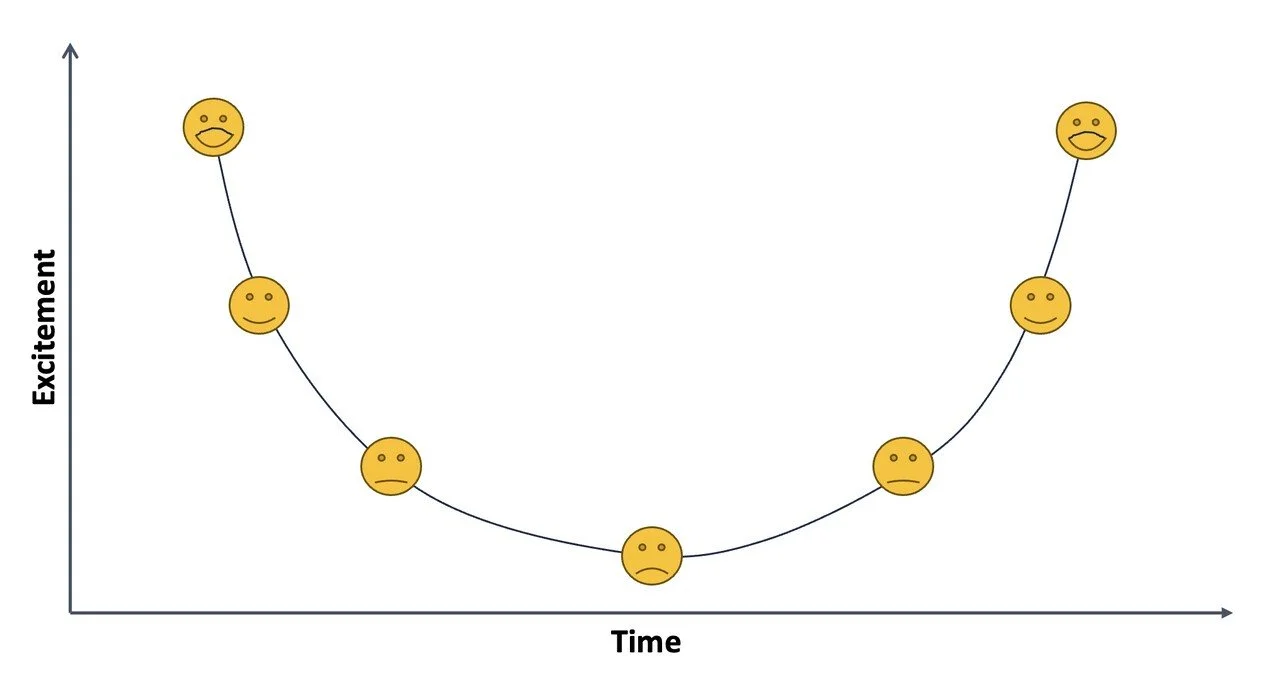
From my experience and from others I've talked to, what plays out is a u-shaped emotional rollercoaster in 3 phases
Phase 1: Euphoria
At the start, your people are all in. Enthusiastically "messing around" with the tool, learning the possibilities, documenting possible use cases that could help them be more productive, efficient, innovative, etc. and allowing them to focus on the strategic, big-picture work.
But something happens after they start to really use the tool critically. The quick prompts they are using with the out-of-the-box platform don't come back with the perfect output. And the more they try to maneuver, the worse it gets.
Phase 2: Disillusionment
It's at this stage where people may start to feel that the amount of effort needed to get to the quality they need is more time-consuming than doing it the old-fashion way.
This is a program managers worst nightmare. You might hear rumblings about the tools not being useful start to creep in. You may see some negative feedback, with people agreeing to it in a group chat. And even a downtick in monthly/daily active users.
It's at this point where the amount of change management support, the program manager and leadership are absolutely critical. While of course the C-suite was critical to buying into the vision, the leaders who know and use the platforms for their work are a critical part of getting folks past this phase. Your people have to trust that leadership is committed — by demonstration.
One of the key tactics I've personally used many times is "scheduling playtime" with people. Think of it like a 10-minute break with the change lead or program manager and the individual struggling with their use case—the idea is to see if live workshopping the answer with the tool can be done quickly to get them back on the right track.
In most cases, I've found it's just a quick nuance of using the tool that was the issue - they are all a bit different. However, just being there to support them and showing them how a quick adjustment gets them what they need will start to push them back up the excitement curve...
And there are many other benefits to scheduling playtime. But that's for another listen (~20 min mark).
Make no mistake about it, this phase is hard work. From understanding the process of work, the data that's needed to power it, the ability to really describe the style of the outputs needed, the nuances of the tools and driving customizations to get to the outcome needed.
But once they do...
Phase 3: Cautiously optimistic -> Excited
If you can get people to push through phase 2, do the hard work of retraining their brain to work differently, tune the tools to work the way you need them to and more, the promise of what can be will finally be realized.
First the "I can't imagine life before this" starts. Then an uptick of people willingly posting their successes to their internal company platforms where they were shy before. The internal community you set up to help bring teams together is suddenly flush with positive comments. It's amazing.
Just how long it takes your teams to get here can vary—but I promise you, getting to phase 3 is worth every minute.
In summary...
Tell your people at the outset that the U-curve is normal. Acknowledging the reality will build organizational trust and help you (and them) get through the lows of phase 2.
If somehow you've managed to skip phase 2, please tell me your secret in the comments...all thoughts welcome.